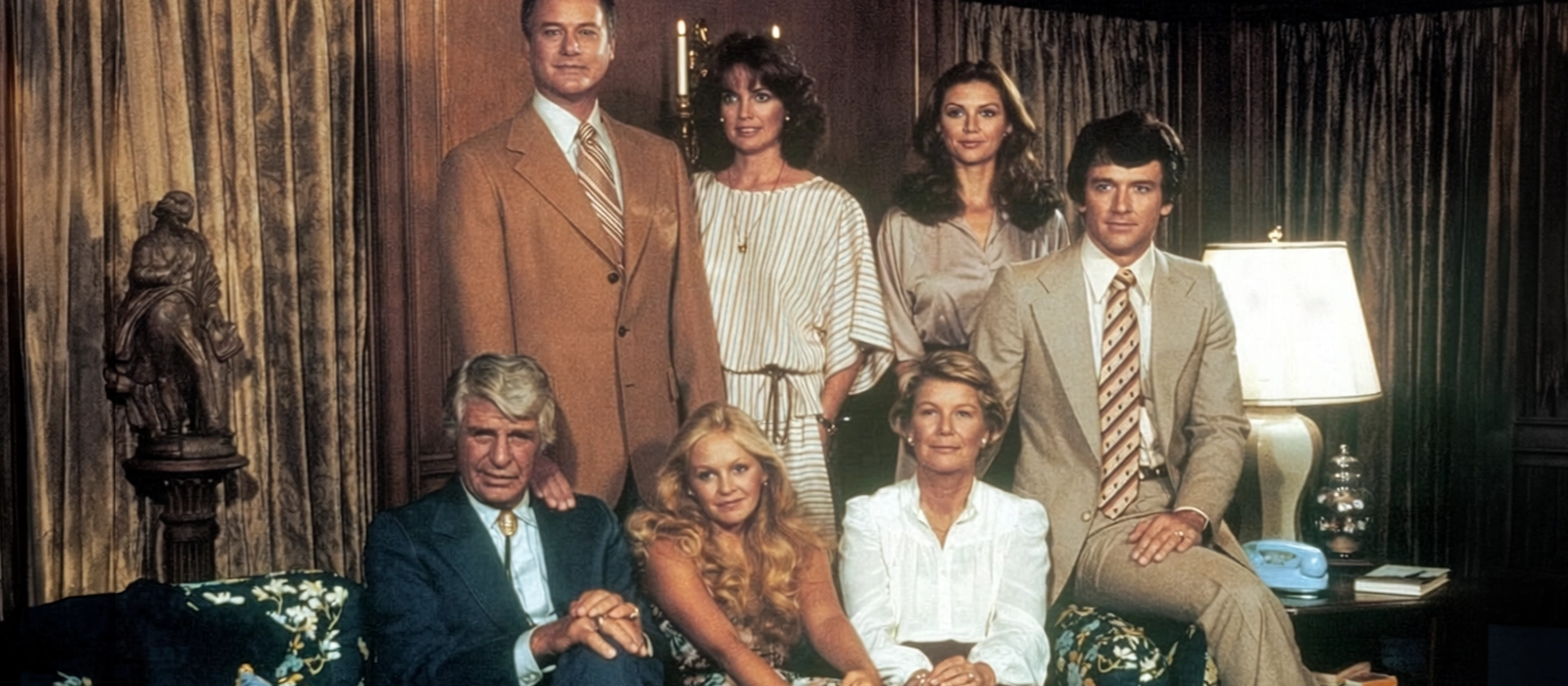
The Ewing sons
Miss Ellie: These boys of mine. You should have seen them when they were growing up.
JR: I've been special my whole life. There isn't anything I wanted I didn't get.
Miss Ellie: JR was so quiet, so shy. When I took him shopping, he held on to my skirts so tight. I think Jock scared him at first, and then when Gary came along, Jock just took over raising JR. "Make him a man's man," he said.
Jock: I used to spend a lot of time with JR, fishing, hunting, when he was a kid, and one thing I drilled into him was how to signal for help if he was ever out alone, lost or hurt - three of anything: shots, fires, mirror flashes.
JR: Daddy took me out [hunting], oh, just when I first started walking. He could find his way through the woods and swamps, across deserts.
Clayton Farlow: I figure JR never helped with the round up [on Southfork]?
Sue Ellen Ewing, JR's wife: No, he was always busy trying to prove to his daddy that he could run Ewing Oil.
JR to Jock: Daddy, I always tried to please you. Always tried to do what you wanted me to do. Always tried to be the man you wanted me to become.
JR: Ever since I was a little boy, Ewing Oil has meant so much to me.
Miss Ellie to JR: You were a small child when I stopped interfering in your life. I gave you up too soon. I should have held onto you a little longer.
Miss Ellie: I guess that's why I fussed over Gary so much, because Jock had JR.
Bobby: Mama, she always, always liked Gary the best.
Garrison on Gary: You named him after me.
Miss Ellie: I never knew how alike the two of you were. Both wanderers, both drifters.
Miss Ellie: Gary was a lot like my daddy, always in trouble with Jock.
Bobby on Gary: "A Southworth among Ewings," she used to call him.
Miss Ellie: Gary was always the cowboy among my sons. He really loved this ranch.
Gary: All my life, the only time I ever felt happy was working the ranch. I don't know, I can't explain it. It's something about the rhythm of it, the seasons, I don't know, but it's in me. It's part of me.
Bobby: I was raised by a strong mother and a very tough father.
Miss Ellie: Bobby was given everything that JR had to fight for, and Gary didn't care about. We all spoiled him
Digger and Rebecca
Cliff on Digger: He loved Mama.
Pam: Did he? He never says that. When he speaks of her at all it's with a kind of reverence, but not the kind of passion he seems to feel for Miss Ellie.
Maggie Monahan on Rebecca: She wasn't from around here. Never did get it straight exactly where she was from. Oklahoma, maybe, or Tennessee. [Digger] married her on the rebound, we figured. But I think he grew to love her. He seemed to.
Cliff: I had an older brother, Tyler. He died when he was six months old.
Digger to Cliff: My whole life, I never got one thing I wanted, except you.
JR on Cliff: He's hated this family since the day he was born.
Cliff: And there was a girl between Pam and myself, she died before she was a year old. And we never found out why.
Digger: We were living in Braddock, maybe a mile from Southfork.
Miss Ellie to Pam: I only met your mother a few times. None of us knew Rebecca very well. You know what Digger was like, drunk so much of the time and disappearing for months.
Enter Hutch McKinney
Deputy Sheriff Newly on Hutch McKinney: He was foreman on the Southfork for a couple of years. He had a bad temper. He was a touchy guy. He used to get in fights all the time.
Jock on his Colt 38: I noticed it missing one day.
Assistant DA Sloane to JR: It must have been a very special gun to your daddy. He probably kept it well oiled and clean all the time.
JR: He did.
Sloane: Any mention of it when it went missing?
JR: No. Well, I don't remember. I was just a little kid at the time.
Sloane: Did you see that gun again after it disappeared?
JR: No.
Jock on the gun: I thought I lost it. That's the reason I never said anything. I guess McKinney stole it.
Newly on Hutch McKinney and Jock: There was bad blood between them. They hated each other's guts.
Verno Ferris, Braddock local: It was 1952. Eisenhower had just beat the pants off of that Stephenson guy. It was a couple of weeks after the election. Some of us were still celebrating.
Jock: I found out that Hutch had been cutting steers, selling them and getting kick back on the feed money. Maybe he'd padded some other bills too, I didn't have time to check. He'd been up at Two-Stick Pasture all day and I just couldn't talk to him. But I knew that he and some of the boys liked to stop by The Braddock Saloon and have a few belts after they'd finished work. It was the only saloon in town at the time. But by then I was so damn mad, I couldn't wait for him to get back to the bunk house so I drove into town to meet him. Well, I got there a little early and had four or five belts before Hutch arrived. He was surprised to see me.
Verno Ferris: Right there in the bar, Jock fired [McKinney]. He ordered him to leave the ranch by morning, or he was going to kill him.
Jock: Then all hell broke loose.
Verno Ferris: Hutch McKinney and Jock Ewing almost tore the place apart.
Jock on McKinney: He picked himself up and left.
Virgil Tuttle, ranch worker on Southfork: Old Hutch, he started coming in the bunk house. He went over to his bed and he spread out, and in no time at all, he's snoring. When old Hutch gets to snoring, I could tell you stories. About midnight, the door of the bunk house flew open and Jock Ewing come in.
Jock on Hutch: He was asleep in the bunk house with an empty jug of gin beside him.
Tuttle on Jock: He went over and pulled old Hutch right out of the bed, and he warned him what would happen if he found him on Southfork - he'd kill him.
Jock on Hutch: I jerked him outside and we went at it again.
Tuttle: I figured I best stay put.
Jock: I guess I just lost all control, I was so damn mad.
Tuttle on Jock: He came in to wash up. He had blood splattered all over him.
Sloane: Did you ever see Hutch McKinney again after that night?
Tuttle: Never did.
Digger: I was drinking. It was another of those three day benders. I came home to your mama, Pam, Cliff. Like I always did. Only this time, it wasn't the same.
Digger in 1952: Hey, what are you doing here, McKinney?
Rebecca: Digger, Jock fired Hutch. He's leaving Dallas. I'm going with him. I'm in love with him.
Digger: You're pregnant. What about my baby?
Rebecca: Digger, Hutch is the daddy.
Digger, striking Rebecca: You whore!
(Digger and Hutch fight.)
Hutch, pulling Jock's gun on Digger: Say your prayers, Digger.
(Rebecca knocks the gun from Hutch's hand. Digger picks it up.)
Hutch: Don't shoot!
(Digger shoots Hutch.)
Digger: I dragged him outside, put him in my car. I buried the body in the first open space I saw. I realised later it was a section of Southfork.
Maggie on Digger: He was upset about something. That's all I knew.
Digger: I took Becky and Cliff and we moved to Corpus Christi.
Corpus Christi woman on Rebecca: She was a nice woman and beautiful. She was pregnant. Big with it, she was.
Pam to Digger: What about the baby?
Bobby: The baby McKinney fathered?
Digger: I always loved you, Pam. Just like you were my own.
Rebecca to Pam: You were a happy baby. You giggled and laughed. You were never a howler.
Pam: When did I start walking?
Rebecca: You were young, just ten months. I remember we were all in the living room and you just stood up and walked clear across the room to Digger, just like that.
Corpus Christi woman: One Christmas, I went to visit my brother in Galveston. I stayed a few weeks, came back and [Rebecca] was gone. The whole family, gone. Nobody knew [where]. I asked, but nobody knew.
Maggie on Digger: I didn't see him again till he turned up on my doorstep with you two [Cliff and Pam] saying Becky was dead. He left you, these trunks, and off he went again.
Rebecca's story
Pam on Rebecca: Someone saw her in a small town [Kingsville], just thirty miles south of Corpus Christi. It was three months after Digger said she died.
Rebecca to Pam: I was seventeen. I could barely read or write. I wasn't ready to be a wife or a mother. And Digger, Digger was destroying me. I didn't want to leave you, but I had to save myself and somehow I found the strength to do it.
John Mackey, private detective, on Rebecca: She worked as a waitress for a while at Jerry's Coffee Shop. She met a travelling salesman. They left Kingsville together.
Rebecca Barnes Wentworth: I closed a door in my mind. I sealed off a part of my life - the awful, awful pain of having to abandon my own flesh and blood.
John Mackey: She must have changed her name every twenty minutes back then, the last being Rebecca Burke.
Clayton Farlow on Rebecca: She scratched her way over the tough side of the tracks. Taught herself how to type so she could work at something else besides waitressing. Practically taught herself how to read.
John Mackey to Pam: Your mother was a very clever woman. She knew she wouldn't get what she wanted out of life by waiting tables so when she got to Houston, she put herself through a good secretarial school where she learned stenography, typing, that sort of thing, and she was good at it. When she graduated, she landed herself a job with the brokerage firm of Wentworth and Pitts. She was good, efficient, and her looks didn't hurt either. After a while, she found her way into the office of the president himself, Mr Wentworth, and became his executive secretary. One thing led to another and, some time after that, he asked her to marry him.
Rebecca: I never divorced Digger. I was afraid that if I tried, he'd find me and drag me back to that awful life.
John Mackey: Rebecca Barnes Burke became Mrs Rebecca Wentworth. [They had] a daughter, Katherine.
Rebecca: I saw a chance for happiness and I took it. I led a comfortable life, happily married to a man I adore.
Life without Rebecca
Pam to Rebecca: When Digger told us that you died, I could never really accept that. I used to think about you every day, my mother who died and went to Heaven, and I used to wonder what you were like, what you smelled like. Sometimes I even thought I could remember.
Cliff to Rebecca: You ran out on me. I was barely five years old and you pretended to be dead. You left me with a baby sister and a drunken father.
Pam: I didn't have much of a home when I was little.
Cliff to Pam: You babbled all the time. Aunt Maggie couldn't shut you up.
Pam to Maggie: You raised me and Cliff and [Maggie's son] Jimmy, and cared for Digger, all in this one little house. I think it's remarkable.
Maggie: I enjoyed it, most of it.
Pam: After everything Digger had told me about the Ewings, I thought they were a family of monsters. I [was] always so sure that the Ewings were the bad guys. They're the ones who'd do anything to anyone.
Cliff to Pam: You used to be worse than I was, breaking up windows in the Ewing building down town. You used to plot revenge.
Pam to Cliff: When we were growing up, I thought you were the most wonderful thing that ever happened. We really were two poor kids from the wrong side of the tracks.
Growing up on Southfork
Miss Ellie on Bobby's tree house: Jock built it for him. Whenever he wanted time off from his chores, he used to be here. He'd swim in that pond. It's not very deep. He always called it his very own lake. Of all the places in Southfork where he used to play, this was his favourite. Gary used to come out here. The two of them would spend hours and hours doing ... I don't know what. JR always seemed to care more about the oil business. He was always trying to get to go out to work with Jock. Or he'd be out in the oil fields with him. When the other boys were playing, JR was learning from Jock. But I think he would have traded everything if he'd been the one that Jock built this tree house for.
Bobby: One birthday, I came home and there was a merry-go-round in the front yard. Not one of those dinky little things you find in front of a supermarket, but an honest to God merry-go-round, with music and mirrors and hand carved horses. He [Jock] would give me anything if I asked for it.
Jock: I spoiled Bobby rotten. He turned out the best of lot.
Bobby on Jock: You know what gave me the most pleasure? Just spending the day with him - we'd go to the office or out in the oil field - just to be with him.
Pam: You two always had a special relationship.
Miss Ellie: Bobby was always Jock's favourite. If ever there was a fair haired son, Bobby was it for Jock. JR always knew that Jock loved Bobby the best and it hurt him. He could never come to grips with the fact that he wasn't Jock's favourite.
JR on playing touch football with his brothers: Old Bobby was the power house. If he couldn't outrun you, he'd try and bite you on the knee.
Bobby to JR: You had the best hidden ball trick in Dallas.
JR: That's what made me so successful.
Gary: Yeah, we did have some great games.
Ray's story
Amos Krebbs on his fiancee, Margaret Hunter: There I was - good old 4F Amos Krebbs. I had to wait till the whole war was over before she'd come home to Kansas, and then I had to put up with the fact that she'd fallen for some Texas colonel.
Lil Trotter, Margaret's sister: I often thought that she married Amos because she was missing Jock so much.
Amos: When I married her, Margaret was already pregnant.
Lil: She had a hard time with Amos Krebbs, harder than she deserved. I never thought that Amos Krebbs was the right kind of husband for [her]. I told her that. I told him that, too.
Amos: I was kind of angry at one point there. That's how come I happened to steal [her diary].
An extract from Margaret Krebbs' diary, dated October 19th 1946: "Raymond's first birthday. I feel so depressed today. Jock, if you only knew how much your son and I miss you. I long to talk to you, to see you, but I won't come between you and your family. I cannot."
Lil: She never said a word [about Ray's true paternity].
Amos to Jock: She never really did get over you.
Lil on Amos: He certainly wasn't the right kind of father for Raymond.
Amos on Ray: I raised him for three years.
Ray to Amos: You ran off on me and Ma. You never come back once, never wrote no letters, sent no money, nothing.
Amos: I didn't have it to send. I tell you, things just weren't good for me.
Ray: Basically, you just never gave a damn.
Ray: I never had a home much or anything. I was just this skinny, useless kid, tired of drifting, running from the law, juvenile authorities. Mama died. [I] showed up at Southfork one day. No place else to go, just the clothes on my back and a note from my mama to Jock Ewing asking him to help me out. I've always loved that ranch, been sort of a home for me.
Jock to Ray: You were the skinniest kid of fifteen that I ever saw in my life.
Ray: Old Jock gave me a job right on the spot. He didn't have to take me in, but he did.
Jock to Ray: No doubt about my hiring you. I knew you'd stick around and work your tail off. I was glad to have you.
JR on Ray: He wouldn't walk into this house without first asking permission.
Ray: For most of my life, I've been kind of a loner. Never been able to talk to anybody, except for Jock. With his help, I pulled myself up and I made something out of my life. Jock Ewing has been more of a father to me than you [Amos] have ever been.
Ray on Jock: How I used to look up to him when I was a kid, how I idolised him. I'd goof something up, though, and he'd chew me up one side and down the other. And I thought, "How could somebody I idolise act like that?" Now I know he was concerned about me, teaching me. He knew when to be firm, and when to be affectionate. He was all those things, but mostly I guess I thought he was almost perfect.
JR: Mama, you don't know the half of what Daddy did when he was running Ewing Oil. Now he was a fair man, but he was tough and ruthless when he had to be. He brought strong leadership to the company and strong leadership to the family.
Ray: I remember running into this guy in a bar, and he called Jock a land grabbing crook. I belted that guy right on the spot. The thing is, though, he may have had his reasons. I didn't think so then. I thought of Jock as almost like a god, but he wasn't. He was a man, just like anybody else. He had friends, he had lots of friends, but he had enemies too. He was human, ambitious. He knew that the oil game was rough, hardball all the way, but he wanted what was best for his wife and for his sons. He did what he thought was right.
JR: My daddy made Ewing Oil the Number One independent oil company in Dallas.
Huntin', Fishin', Cowboyin'
JR: I wonder how many hours Daddy had us out there, practising [our rodeo skills]?
Bobby: If I remember right, you didn't take to it. It was mostly Gary and me. Ever since I can remember, all you ever thought about was running Ewing Oil. By the time I was three years old, I knew the Red Files meant "current" and "important".
Gary: I never could figure out the oil business.
Miss Ellie to Jock: Remember that hunting preserve in Cato Lake, on the Louisianna side? You used to hunt there a lot when the boys were small.
Jock: A place called Land Down. Beautiful country. You could bag a dozen birds, just like that.
JR on Jock: I remember when he used to take all four of us out hunting.
Ray : All those ghost stories he used to tell us round the camp fire. I can remember Gary sitting there, frozen in terror.
Bobby to Ray: Gary? I remember you, sitting on your hands to keep them from shaking.
JR to Bobby: Now hold on, old Ray was the strong one. I remember waking up in the morning with you in my sleeping bag.
Bobby: That was my first hunting trip, and I was only seven years old. You'd been there before, you'd heard all those stories. I remember how mad I was because Daddy wouldn't let me carry a gun.
Bobby to JR: You taught me how to use these guns when we were boys. I think we were the closest then. What I liked best was when we'd go salmon fishing in Alaska.
JR: Gary wasn't into things like that. I remember the first time he had to bait his own hook he almost fainted! He was different from the rest of us. For one thing, he used to like to write poetry. Now can you imagine a real man who would rather write poetry than go hunting? Not me!
Gary to Bobby: You were the only one that took me seriously, you and Mama. Yeah, I'd tell you about growing things and what to look for in fine cattle.
Bobby: And about your drawings, your wanting to paint. You never made me feel like a little brother.
Bobby to Miss Ellie: Ever since I was a little boy, I could only speak to two people - you and Gary.
Bobby to Gary: When we were kids, you and I found a mare running wild. Daddy promised she'd be mine if I could break her. He never knew you did it for me. You almost broke your back in the process.
JR grows up
Cliff: Wally Hampton and JR not only went to the same university, but they were also in the same fraternity.
JR: When I was in the service, I spent a lot of time in Japan. I never killed anybody, not even during the war.
Jenna Wade
Miss Ellie: She and her daddy were friends of ours.
Jenna Wade: We used to live on a ranch not more than three miles down the road [from Southfork].
Jock on Bobby: He and Jenna grew up together.
Jenna: When Bobby and I were kids, he used to ride his horse over to see me, and a couple of years later, it was a motorcycle, and then after that a convertible, whenever he could sneak away from his chores. He never liked to work much then.
Punk Anderson on Bobby and Jenna: These two were destined to be together ever since they was kids. I remember me, Jock and Lucas Wade talking about it when we used to hunting together. Y'all [Bobby and Jenna] weren't even up to our belt buckles. As soon as our backs was turned, they were always getting into some kind of devilment.
Bobby to Jenna: You always were unpredictable. If I took my eyes off you for a second, you'd be out of sight.
Ray: Guts is one thing Jenna Wade never lacked.
Miss Ellie: Jenna Wade was never stoical in her life.
Jenna on Lucas Wade and Jock: Their faces when they saw us up on their prize two year olds!
Bobby: What about my face when I saw Daddy standing there when I got down? I didn't think we'd get caught.
Jenna: Who do you think told on us anyway?
Bobby: I still think it was the stable boy. He could have seen us, told your daddy. Your daddy told my daddy.
Jenna: Who won that race? You or me?
Bobby: I don't remember.
Teenage daydreams
Gary: Ever since I was fifteen, I wanted to make a difference, not a big difference, not an earth-shattering difference, just a difference. So that when I died, I could say, "I made a difference. I made something better." But I seemed to have the opposite of the Midas Touch.
Gary: I was fourteen the first time I got drunk. One Saturday night, I sat down and I had three sixteen ounce cans of beer and got drunk as a skunk, sick as a dog. Threw up all over the place. Swore to God I'd never do it again. Next Saturday night - boom - right back out there. And the next. Everybody was doing it. I never drank to get high, I always drank to get drunk. I was out of control from the beginning, but out of fear - or hope - I couldn't admit it to myself. One of the symptoms of my [alcoholism] is to deny that I even have a problem, so I just kept on. I wouldn't listen to anyone. No one could tell me anything. I knew better than anyone else. I was the kind of drunk that had to hit bottom. I had to hurt everybody I loved. I had to hurt everyone who loved me.
Gary: I used to watch those cowboys on those broncs and, man, I wanted to do that. We had this horse on the ranch that was really mean so I'd practice on him. I'd get up on him and he'd throw me, and I'd get back up on him again, but I was determined to get good enough to enter the rodeo. So when I was fifteen, I figured I was ready. My daddy figured otherwise. So all my friends and I, we snuck into the rodeo at night, and I found me the meanest horse they had. And I got on him just to prove to my friends that I could do it. I stayed on for almost eight seconds. The only problem is I had to get drunk in order to do it so when he threw me, I broke my back. Afterwards, my daddy came to see me and it was like, I don't know, like he was proud of me for having the guts to do it.
JR: When Gary was sixteen, he somehow got into his head that he wanted a motorcycle. Now our family spoiled us boys rotten, but on this issue my daddy put his foot down. He said, "You want a motorcycle, you're going to have to earn it." And my God, he did - before dawn, up every day mucking out the stables, pitching hay, working on the rigs in the blazing sun. He just never missed one single day. Come September, my daddy took him down to the show room, gave him a slap on the back and a blank cheque. And of course, Gary had read all the brochures and motorcycle magazines. He knew exactly what he wanted. He signed the cheque, revved that old motorcycle up ... and drove straight through that pate glass window.
Gary: When I was in high school, we used to hang out at a place called Dwight's that had a pinball machine I could never beat. Drove me crazy. I must have played two hundred games on that thing. Then one night I was studying for this big final exam. I took a break, dropped by Dwight's for a hamburger. Afterwards I played the machine and I won. Then I won again. I tell you, there must have been something wrong with it because I played sixteen games on that thing and, test or no test, I had to play them out. And when they closed up the place, I had eight games left. I flunked the exam and never beat that machine again.
Bobby: That's why Daddy turned away from Gary - the Ewings must succeed, and Gary didn't care about that. But JR and I do.
JR on Gary: He was always weak.
Sue Ellen: Is that why you drove him away?
JR: I did not drive him away. I tried everything I could to keep him around here. I had plans for him. He was going to college.