Dallas Scripts
How scripts were written, revised, and distributed — plus official Dallas TV script downloads in PDF format.
“There’s an emphasis on character and a de-emphasis on plot.” — Katzman
OFFICIAL DALLAS TV SCRIPT DOWNLOADS
These are original scripts prior to post production. They include slug lines and personal direction but most omit camera direction.
All scripts are in .PDF format and can be viewed in Adobe Acrobat.
To download right click on script link below and select 'Save target as'
| Writer | Script | Download size | Download |
|---|---|---|---|
| David Jacobs | The Pilot (First draft) aka Diggers Daughter | 2.18 MB | pilot.pdf |
| Peter Dunne | Winds of Change (First draft) | 2.24 MB | change.pdf |
Scene Length
Scenes in a Dallas script are shorter than in almost every other show. The average scene is about two or two and a half pages of dialogue, whereas in another show, a scene can run from five to eight pages. "There’s an emphasis on character and a deemphasis on plot," says Katzman. Still, a lot more happens on an episode of Dallas than on almost any other show on television.
How Scripts Were Written
Scripts are mostly written by house writers, but occasionally they are farmed out to freelancers. Freelance writers are handed a scene-by-scene outline (called a "step-outline") of the show they are to write. They spend a week "thinking about it," according to the supervising producer, Peter Dunne. "They are encouraged to call me at any time to ask any questions they want." After a week the writers go to the offices on the MGM lot to discuss their thoughts about action and motivation. Then they go home to write for another week, turning in a script that is about fifty-two pages long – approximately one page of dialogue per film minute. Writers earn approximately $16,000 for a script. Sounds easy? It isn’t.
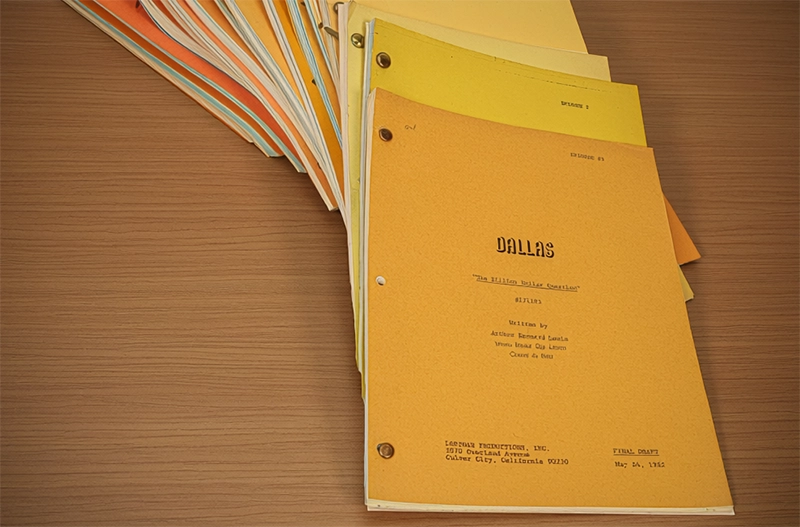
Red Covers & Yellow Covers
The first draft of a script is bound between red paper covers and is called, not surprisingly, a "red cover." The red cover goes to the production people so that they can begin work right away on locations and props. The rewritten version (changed as much as 50 percent) of a script, boasting a yellow cover, is the official shooting script. Yellow covers go to the actors. Pages of subsequent rewrites will be added on various shades of paper, each colour coded to the number of rewrites the scene has endured.
Confidentiality
All copies of all yellow covers contain the same letter, which states, "As you know, our scripts should be treated with the utmost confidentiality, especially those containing sensitive material with regard to the opening and closing sequences of each season. Please do not let your script out of your possession!" High-security pages (such as the ones identifying who shot J.R.) are handed out on a "need to know" basis and may be stamped "For your eyes only."
Camille Marchetta on the Process
Script writer Camille Marchetta explained the process "When I worked on the show, possible stories were suggested and discussed in lengthy meetings involving usually Leonard Katzman, Art Lewis,and myself, with occasional appearances by our executive-producer, Phil Capice. Each of us would suggest ideas that came from our personal experiences as well as from watching the interaction of our characters and imagining how each would react when presented with an obstacle, a problem,etc. We would defend a story idea vigorously until either it was shot down or one of us convinced the others it was brilliant. Once we agreed on the way to go, we would run the ideas by the studio and network executives, incorporate their notes, and proceed to script."
Actors and Story Surprises
Actors rarely know what is happening to their characters before they see their scripts. Often an actor will ask producers for help in understanding his character’s actions, since without knowing where a character is going or what he is thinking a part can be quite difficult to play. The director or producer will then guide the actor through the crisis. Producers invariably know more about the characters’ futures than the actors do.
Dallas Script Writers
Series Writing credits
| Writer | Credits | Notes |
|---|---|---|
| Arthur Bernard Lewis | (57 episodes, 1978-1990) | |
| Leonard Katzman | (43 episodes, 1978-1990) | |
| David Paulsen | (38 episodes, 1981-1988) | Exclusive interview |
| David Jacobs | (12 episodes, 1978-1986) | Exclusive interview |
| Camille Marchetta | (12 episodes, 1978-1980) | Exclusive interview |
| Howard Lakin | (11 episodes, 1980-1990) | |
| Rena Down | (8 episodes, 1978-1981) | |
| Will Lorin | (8 episodes, 1982-1983) | |
| Linda Elstad | (7 episodes, 1980-1983) | |
| Leah Markus | (6 episodes, 1980-1988) | |
| Loraine Despres | (3 episodes, 1979-1980) | |
| Robrrt J. Shaw | (3 episodes, 1980-1981) | |
| Lisa Seidman | (3 episodes, 1989-1991) | |
| D.C. Fontana | (2 episodes, 1978-1979) | |
| Richard Fontana | (2 episodes, 1978-1979) | |
| Worley Thorne | (2 episodes, 1978-1979) | |
| Peter Dunne | (2 episodes, 1985) | |
| Susan Howard | (2 episodes, 1986-1987) | Exclusive interview |
| Calvin Clements Jr. | (2 episodes, 1986) | |
| Virginia Aldridge | (1 episode, 1978) | |
| Darlene Craviotto | (1 episode, 1978) | |
| Jim Inman | (1 episode, 1978) | |
| Louis Elias | (1 episode, 1980) | |
| Barbara Searles | (1 episode, 1980) | |
| Jeff Young | (1 episode, 1980) | |
| Frank Furino | (1 episode, 1983) | |
| Robert Sherman | (1 episode, 1983) | |
| Stephanie Garman | (1 episode, 1986) | |
| Hollace White | (1 episode, 1986) | |
| Mitchell Wayne Katzman | (1 episode, 1987) | |
| Louella Lee Caraway | (1 episode, 1989) | |
| Amy Tebo | (1 episode, 1990) | |
| Bryce Zabel | (unknown episodes, 1989) | |
| Deanne Barkley | ||
| Joel J. Feigenbaum | ||
| Jonathan Hales | ||
| Kenneth Horton | ||
| Simon Masters | ||
| Bill Taub | ||
| Jackie Zabel |