The Making of Dallas
The production schedule was a grind: writers worked nearly year-round, the cast rotated between studio interiors and summer location work, and each episode moved through a tightly timed cycle of prep, shooting, and post-production.
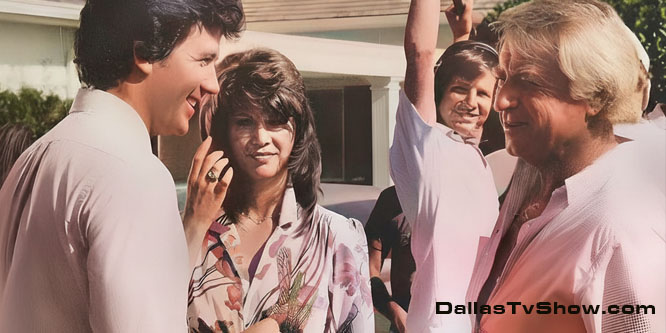
“All right, this is where we ended, now where do we begin?” — Season planning meeting
Calendar & Hiatus
The writers worked all year except for a week at Christmas; the actors had a hiatus between the first of April, when the filming season wrapped, and the first of June, when they reported to work at MGM-Lorimar Studios to shoot interiors for the first six shows of the new season. Then they migrated to Dallas from mid-June to mid-August to shoot exteriors for twelve shows.
While in Dallas, cast and crew worked six days a week (Sundays were off); key producers and production personnel would throw in an additional half day on Sunday as required.
How a New Season Began
A new season officially started the day after the old season, when Capice, Katzman and the Dallas creative staff sat down and said, “All right, this is where we ended, now where do we begin?” The bible was worked out and new actors in supporting roles were signed. (One-shot actors would be cast as each script was developed.)
The Bible, Casting, and Trying Out Characters
“We differ from some of the other shows in casting,” said Capice. “I think that other shows go after a big name and then create a part for that person to play and work it into the story. On Dallas, the story always came first. We shied away from a big name actor who was best known for being himself. We wanted our audience to accept the actor as the character.”
When an actor was signed for multiple appearances (a minimum of seven shows), he did not know what would happen to his character in the story or how long he would be around. During the show’s developing years, it was not unusual for characters to be tried out. Both Dale Robertson and Howard Keel played suitors to Miss Ellie, but Robertson’s character disappeared into the sunset.
Plotting the Story: Acts, Scenes, and Cliffhangers
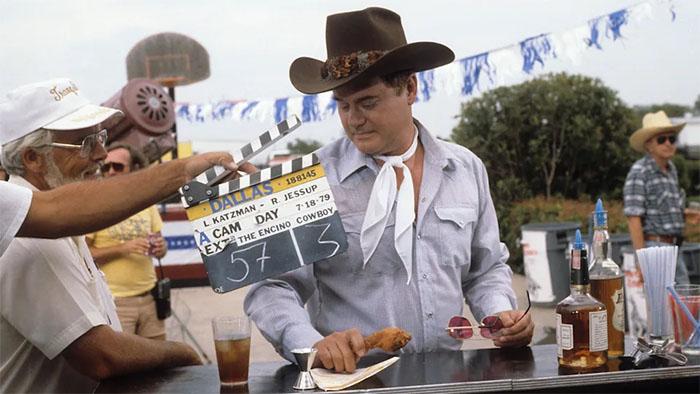
After the twelve-show bible was developed, each show would be plotted act by act and scene by scene. There were approximately twenty-five scenes in each Dallas script, divided equally into four acts. The act climaxes were chosen as the story was developed orally. (Each act climax was a mini cliffhanger that served to move the story toward a greater climax while allowing commercial breaks.)
Prep Days, Shoot Days, and Directors
A show traditionally took seven “prep” days and seven “shoot” days. Although the prep days actually involved only the director and production personnel, the script had to be finished before they began. Directors were contracted by the producer’s office on a show-by-show basis. Several directors had multiple deals (for two to six shows a season), but each episode was still assigned separately. Directors were paid the union minimum of approximately $16,800 for the fifteen days they worked [≈ $50,000 in 2026]. They also received residuals if the show was rerun or went into syndication.
A show traditionally took seven “prep” days and seven “shoot” days. Although the prep days actually involved only the director and production personnel, the script had to be finished before they began. Directors were contracted by the producer’s office on a show-by-show basis. Several directors had multiple deals (for two to six shows a season), but each episode was still assigned separately. Directors were paid the union minimum of approximately $16,800 for the fifteen days they worked [≈ $50,000 in 2026]. They also received residuals if the show was rerun or went into syndication.
Production Meeting, Budgets, and the Grind
At the production meeting before shooting, the director would run through each scene and explain to the heads of departments – props, costumes, sets, and so forth – just how he envisioned each scene. After the meeting, department heads would work up their budgets for the show. The producers and budget director would then decide if the director’s version was “doable.”
The experienced director would ask only for things he knew could be covered in the budget (about $1 million an episode [≈ $3 million in 2026]) and knew how to keep cast and crew in good spirits through the pace of the grind. The job was technically, physically, and politically demanding.
“If a writer makes a mistake, we can fix it,” said Katzman. “For the director, once you have the film, you don’t get another chance. If it's not there, there's nothing we can do.”
Because a show took seven days to shoot, it could become difficult to tell when one show was over and another began. Every Monday did not bring a new episode. The changing faces of the directors were about all that varied in the grueling schedule. While each show had a title, the title was never broadcast and was merely a reference point for writers. Cast and crew referred to shows by their numbers in the sequence of each year – they did not keep a running tab.
Dallas vs. Los Angeles (and Other Locations)
After the Texas shooting, additional episodes were shot on the lot or in the Los Angeles area. The cast and some crew members might return to Dallas for certain night shots or stunt shots. For the show in which Sue Ellen and Mickey Trotter were involved in a car accident in front of Southfork, for example, some of the cast and crew returned to the scene of the crime, and additional local crew were added on.
For the excursion to Hong Kong, Len Katzman accompanied Linda Gray and Victoria Principal, and used a local crew for most of the technical work.
Some location scenes that were meant to be in Dallas were shot in Los Angeles – Lorimar leased a ranch (J.M.J.) in Hidden Hills, California, that doubled as the back prairie of Southfork. Restaurant scenes could be shot in nearly any area restaurant or on a soundstage. Patricia Shepard's home existed not in the posh Dallas suburb of Turtle Creek, but in Hancock Park, a wealthy residential area of Los Angeles. The Oil Baron’s Club was a standing set on Stage 5 at MGM.
Makeup Calls, Walk-throughs, and Timing
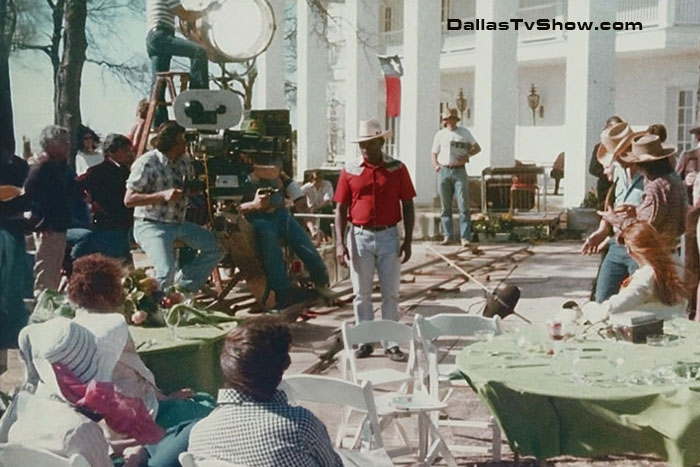
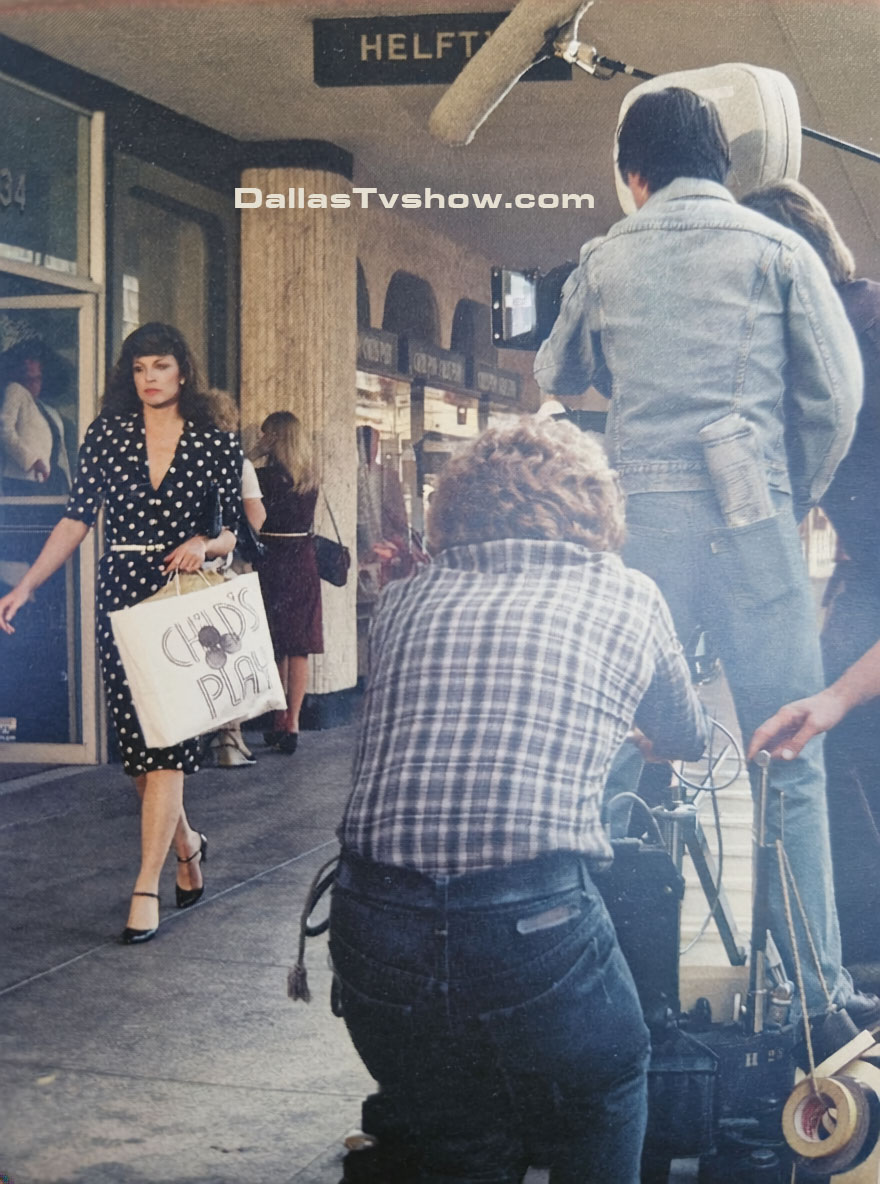
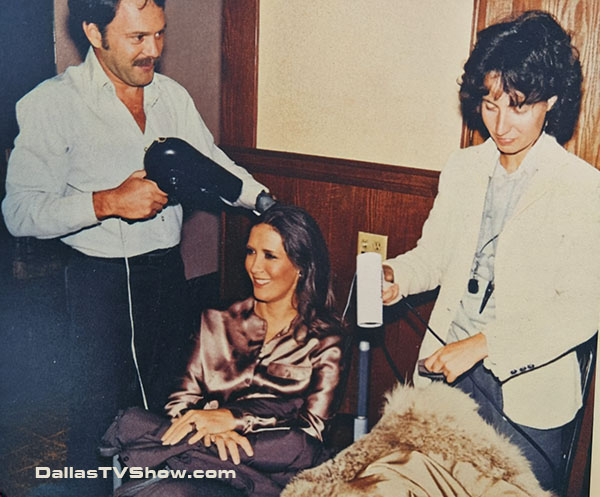
Work invariably began with a 5:30 A.M. makeup call for some of the actors and a 7:18 A.M. call for crew. The first shot usually took place around 8:00 A.M., as soon as the set was ready. Actors had to be ready and waiting. Since production time was money, actors stood by in their dressing rooms and were brought to the set about two minutes prior to the first walk-through. In addition to rehearsals, the actors would perform at least one walk-through for the camera. They were already in makeup and wardrobe but draped with large, white, paper napkins at the throat to prevent makeup from ruining their clothes. Additional walk-throughs might be done for lighting or tricky camera shots.
Rehearsal, Takes, Coverage, and Cameras
Each scene would be rehearsed once and then filmed, usually twice – unless the first take was astoundingly perfect or the shot was a complicated track shot with a moving camera. After the scene was done, it would be “covered” from several other angles; each angle would favor one of the speaking actors. In editing, the various versions would be cut together so the viewer saw the speaker and one or more reactions.
Film shows such as Dallas rarely used more than one camera (videotaped shows usually used three cameras) because the look and feel of the film was based upon the quality of the lighting. Two cameras might be used on an elaborate stunt, but otherwise the lighting would be adjusted to best flatter each situation and actor.
The day’s work usually wrapped around 6:00 – 6:30 P.M., but could extend until later depending on the demands of the schedule. The director tried to accomplish all the assigned work on a daily call sheet because there was no room in the schedule to bump over to the next day. Only once, when both Barbara Bel Geddes and Victoria Principal were out ill, was the set closed down and the schedule readjusted accordingly.
Call Sheets, Scheduling, and Pay
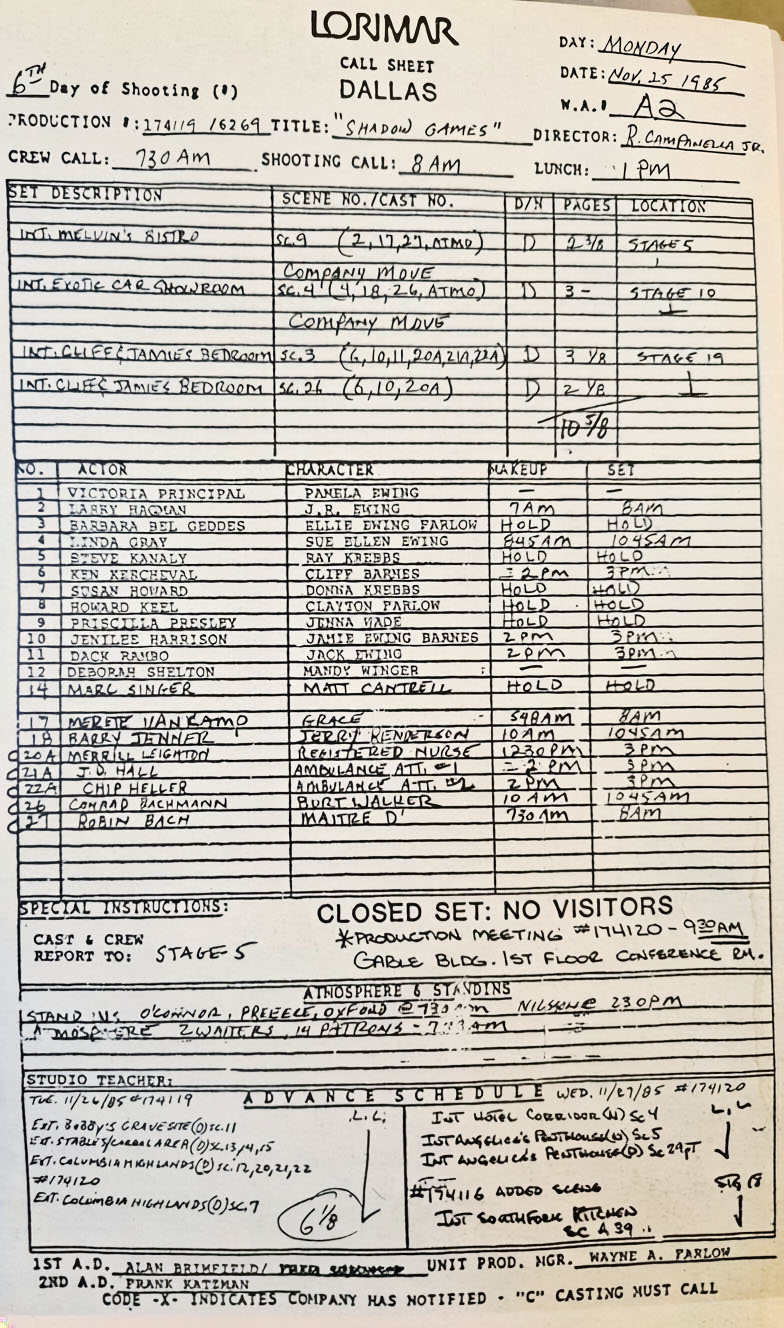
Of course, not every actor worked every day and not every actor had scenes with all the other actors. Cliff Barnes and Miss Ellie were rarely on camera together. After Pam and Bobby’s divorce, Victoria Principal was no longer needed for family living room and dinner scenes. The production office scheduled the scenes for each day, the actors needed, and the arrival times for makeup and on set. A “call sheet” was issued around 3:00 P.M. of the day prior to the shoot. Actors had to phone in for their “call.” If they were not working the next day, the call sheet was marked with an “H” for holding.
All actors were paid on a per episode basis, with fees ranging from around $5,000 an episode to over $100,000, unless they were day players [≈ $15,000 to ≈ $300,000 in 2026]. Since day players only worked one day, they were paid only for that day. Sometimes an actor beginning as a day player became a contract player—if his/her character became a regular. Actors who directed were paid $16,800 per an episode [≈ $50,000 in 2026]. Only principal actors were considered for directing jobs.